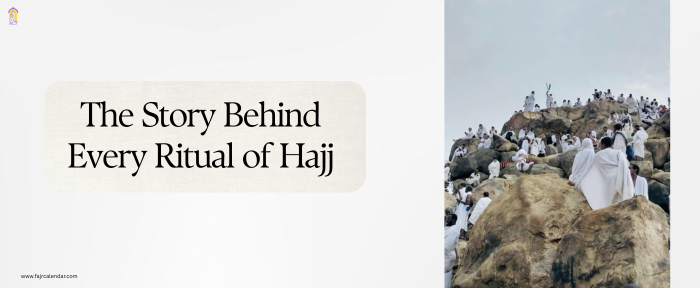
It’s this time of year when you see millions of people stripped of their designer labels, their ranks, their nationalities, and their wealth, covering Mount Arafat. Every pilgrim wearing the same two unstitched white cloths.
A shepherd stands beside an engineer. A doctor beside a grandmother. All of them, together, raising their hands to the sky and whispering the same words:
"Labbayk Allahumma Labbayk."
"Here I am, O Allah. Here I am."
This is Hajj, the Fifth Pillar of Islam, and one of the most extraordinary gatherings of human beings on earth. More than a pilgrimage, it is a reenactment of Prophet Ibrahim (AS), his wife Hajar, and their son Isma’il’s absolute surrender to the command of Allah.
It is, as many scholars describe it, a rebirth: you arrive carrying the weight of a lifetime, and if your Hajj is accepted, you leave as clean as the day you were born.
But to truly understand Hajj, you must go back. Way back. To a barren valley, a desperate mother, and a father whose love for Allah was stronger than anything in this world.
The Legacy of Prophet Ibrahim (AS) and the Foundations of Hajj
The Command and Ultimate Trust
No story in the history of monotheism is as layered with trial and trust as the story of Ibrahim (AS), the Khalilullah. He was a man who was tested not once, but repeatedly, throughout his entire life. And all the rituals of the Hajj go back directly to those tests.
The first great trial associated with Hajj was an order that would break any normal parent. Take your wife, Hajar, and your infant son, Isma’il, to the desert valley of Makkah, a place with no water, no food, and no people, and leave them there. No reason given. Just trust.
And Ibrahim (AS) obeyed.
As he turned to walk away, Hajar called after him. She asked him, again and again, if this was the command of Allah. When he confirmed it was, she said words that echo through every generation of believers: "Then Allah will not abandon us."
The Miracle of Zamzam and the Origin of Sa'i
Why do we run between Safa and Marwa?
Alone with her infant, Hajar watched her water run out. Isma'il cried from thirst. She ran desperately and urgently between the two small hills of Safa and Marwa, searching for any sign of water or passing people. She ran this path seven times.
It was on the seventh run that the miracle came. Jibril (AS) struck the earth near the infant's feet, and water burst forth from the ground. The well of Zamzam. Water that has never run dry in over four thousand years.
Every pilgrim who performs Sa'i today, which is the act of running seven times between Safa and Marwa, is not merely completing a ritual. They are retracing the steps of a mother's faith.
Allah says in the Quran:
“Indeed, as-Safa and al-Marwah are among the symbols of Allah. So whoever makes Hajj to the House or performs 'umrah - there is no blame upon him for walking between them. And whoever volunteers good - then indeed, Allah is appreciative and knowing." (Surah Al-Baqarah, 2:158)
Prophet Ibrahim’s Dream and the Origin of Qurban (Sacrifice)
Years passed. Isma'il grew into a young man of remarkable character. Then came the most shattering test of all.
Ibrahim (AS) saw in a dream (and the dreams of prophets are revelation) that he was sacrificing his son. He told Isma'il (AS). And in one of the most beautiful exchanges in all of scripture, his son replied, "O my father, do what you are commanded. You will find me, if Allah wills, among the steadfast." (Surah As-Saffat, 37:102)
As Ibrahim raised the knife, Jibril (AS) descended, called out to stop him, and told him to replace Isma'il with a great ram. The test was never about the sacrifice itself; it was about the unconditional surrender of the heart, and Allah had accepted Ibrahim’s (AS) intention.
This is the foundation of Eid al-Adha, celebrated on the 10th of Dhul-Hijjah, the day the world pauses to remember that we own nothing, not even our most beloved, except by the mercy of Allah.
Building the Kaaba
After this, Allah commanded Ibrahim and Isma'il to build the Kaaba, the first house of worship on Earth designated for the One God. Father and son raised the walls together, and as they did, they prayed:
“Our Lord! Accept this from us. You are indeed the All-Hearing, All-Knowing.” (Surah Al-Baqarah, 2:127)
Then Ibrahim was commanded to call all of mankind to this place. And since then, every soul that has ever answered the call of Hajj is, in a spiritual sense, answering that ancient cry.
What Are the Main Rituals of Hajj?
In Islam, there is a specific distinction between a pillar (Arkan), a mandatory act (Wajibat), and a Sunnah (recommended).
Missing a pillar invalidates the Hajj entirely, while missing a mandatory act can usually be compensated for by a sacrifice (Dam), though one should strive to complete them all.
Hajj Pillars (Arkan)
If any of these are missed, the Hajj is invalid.
1. Ihram (The Intention & State)
Before crossing designated Miqat points, typically on the 8th Dhul-Hijjah, pilgrims should enter the sacred state of purity (Ihram). This includes bathing, wearing white unstitched garments (for men), making the intention (Niyyah), and reciting the Talbiyah ("Labbayk Allahumma Labbayk...").
For women, it’s the same except they wear ordinary covering clothes. And both men and women are forbidden from wearing perfumes, cutting hair/nails, and engaging in marital relations.
In this state, both the king and the commoner look identical before God, and without it, Hajj is not accepted.
2. Wuquf (Standing) at Arafat
This is the pinnacle of Hajj. The Prophet Muhammad ﷺ said, "Al-Hajju Arafah," which means "Hajj is Arafat."
The standing on the plain of Arafat on the 9th of Dhul-Hijjah is the very heart of Hajj. Without it, Hajj is invalid. Pilgrims stand from Dhuhr until sunset, weeping, supplicating, confessing, and calling to Allah. It is described by scholars as a foretaste of the Day of Judgment, the day all humanity will stand before its Lord.
All a pilgrim has to do is be present within the boundaries of Arafat. It is not literally "standing." They can sit, lean, or lie down. If you are not in Arafat for at least a few moments between Dhuhr and Maghrib on the 9th of Dhu al-Hijjah, you have missed Hajj entirely.
For those not on Hajj, fasting on this day carries extraordinary reward. The Prophet ﷺ said it expiates the sins of the previous year and the coming year.
3. Tawaf Al-Ifadah
Tawaf Al Ifadah is done by circumambulating the Kaaba seven times counterclockwise. It is usually done on the 10th of Dhul-Hijjah after returning from Mina. After completion, you pray two units (Raka'at) of prayer behind the Station of Ibrahim (Maqam Ibrahim).
4. Sa’i
After Tawaf Al-Ifadah, pilgrims must walk seven times between the hills of Safa and Marwa. They start at Safa and end at Marwa. It honors the story of Hagar (Hajar), who ran between these hills searching for water for her son Ismail.
The Mandatory Acts (Wajibat)
Missing these requires a compensatory sacrifice (animal offering), but the Hajj remains valid.
1. Spending the Night at Muzdalifah
After leaving Arafat at sunset on the 9th, you head to the open plains of Muzdalifah. You pray Maghrib and Isha combined.
Most pilgrims gather their pebbles (at least 49 or 70) here for the upcoming stoning rituals. You must stay at least until after midnight.
2. Ramy al-Jamarat (Stoning the Pillars)
Throwing small pebbles at three stone walls (pillars) representing the rejection of the devil's temptation.
Day 10: Stone only the largest pillar (Jamrat al-Aqaba) with 7 pebbles.
Days 11, 12, & 13: Stone all three pillars (small, medium, large) in order with 7 pebbles each.
This is usually done between Dhuhr and Sunset on the days of Tashreeq.
3. Staying (Mabit) in Mina
Pilgrims must spend the majority of the night (more than half) in the tent city of Mina during the nights of the 11th and 12th (and 13th if they don't leave early).
4. Halq or Taqsir (Shaving/Trimming)
After the first stoning on the 10th, men should either shave their heads (Halq) or trim their hair (Taqsir). Women only trim a fingertip's length of their hair.
Once this is done, you enter "Partial Deconsecration." You can take off the Ihram clothes and wear normal clothes, but marital relations remain forbidden until after Tawaf al-Ifadah.
5. Tawaf al-Wada (Farewell Tawaf)
This is the very last thing a pilgrim does before physically leaving Makkah. It is 7 rounds around the Kaaba.
Sunnah Acts (Recommended)
These are highly rewarded but do not require compensation if missed.
Tawaf al-Qudum: The "Arrival Tawaf" performed upon first entering Makkah.
Spending the 8th of Dhul-Hijjah in Mina: Known as the Day of Tarwiyah.
Kissing the Black Stone: If possible without causing harm or crowding.
Reciting the Talbiyah: Constantly chanting "Labbayk Allahumma Labbayk..." from the moment of Ihram until the stoning of the first pillar.
Summary of the Timeline (The 5 Days)
8th Dhul-Hijjah: Enter Ihram, go to Mina.
9th Dhul-Hijjah: Move to Arafat. At sunset, move to Muzdalifah.
10th Dhul-Hijjah: (Eid al-Adha) Return to Mina, stone the big pillar (Jamrat al-Aqaba), sacrifice an animal, shave/cut hair, and perform Tawaf al-Ifadah in Makkah.
11th–13th Dhul-Hijjah: Stay in Mina and stone all three pillars each afternoon.
Departure: Perform the Farewell Tawaf before leaving the city.
Note: While the sequence can feel overwhelming, most pilgrims travel in groups with a guide (Mutawwif) to ensure they are in the right place at the right time.
Hajj 2026 / Hajj 1447: What Pilgrims Should Know
For Hajj 1447 AH / 2026, the key days are expected in the final week of May, with the 8th of Dhul-Hijjah (Tarwiyah Day, departure to Mina) falling around Monday, 25 May; the Day of Arafah on Tuesday, 26 May; and Eid al-Adha on Wednesday, 27 May.
As always, these dates are not fixed; the Islamic lunar calendar depends on the sighting of the moon to determine the start of each month, and confirmation from Saudi authorities is always required.
For pilgrims, the Nusuk app, Saudi Arabia's official Hajj and Umrah management platform, has become indispensable. It handles everything from permit applications and accommodation booking to real-time navigation within the holy sites. Pilgrims are strongly advised to register and manage their rituals through Nusuk well in advance, as the permit system (Tasreeh) is strictly enforced.
Hajj Mabrur!
The Prophet Muhammad ﷺ said:
"An accepted Hajj (Hajj Mabrur) has no reward except Paradise." (Bukhari & Muslim)
Accepted Hajj is not merely Hajj that was "done correctly." It is Hajj that changes you. It is the pilgrimage after which a person returns more patient, more generous, more conscious of Allah, and more at peace with what they have and what they lack.
Every ritual of Hajj is designed to dismantle something inside you: your ego at Ihram, your self-reliance at Sa'i, your sense of entitlement at Arafat, and your attachment to temptation at the Jamarat. And if you truly surrender, as Ibrahim (AS) surrendered, you do not just complete Hajj. Hajj completes you.
Whether you are a pilgrim preparing your Manasek checklist, a member of the global Ummah fasting on the Day of Arafah from Alexandria to Auckland, the call of Ibrahim (AS) still echoes across millennia.
Can you hear it?
Labbayk Allahumma Labbayk.